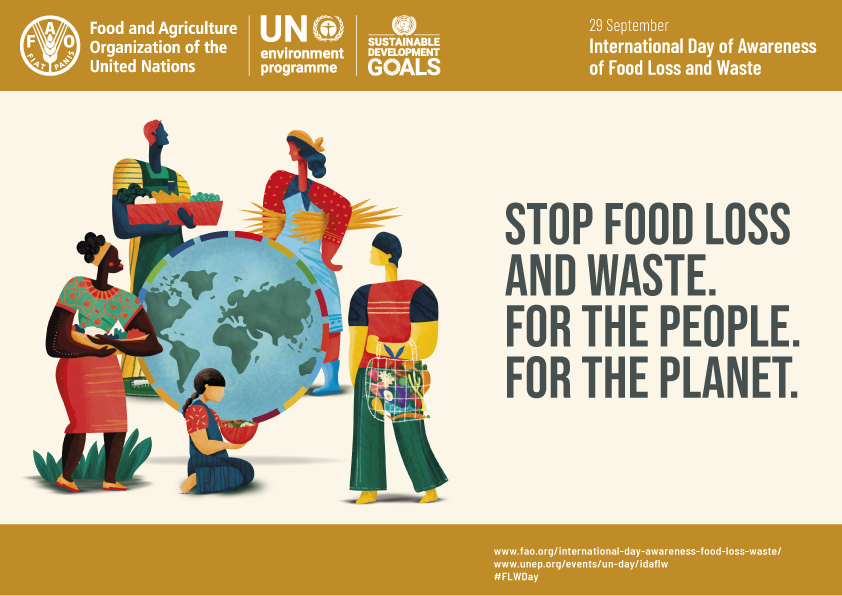
International Day of Awareness of Food Loss and Waste
29 September
The eighth observance of the International Day of Awareness of Food Loss and Waste (IDAFLW) is approaching, now is the time for everyone to get involved and take action. How will you mark the day?
.
Observed annually on September 29, the International Day of Awareness of Food Loss and Waste is a global United Nations initiative. Co-convened by the Food and Agriculture Organization (FAO) and the United Nations Environment Programme (UNEP), it highlights the urgent need to cut food waste, conserve natural resources, and fight global hunger.
.
Why It Matters
• About 14% of the world's food is lost after harvest
• Roughly 17% is wasted at retail and consumer levels
• Food loss and waste generate 8% to 10% of global greenhouse gas emissions.
• Reducing waste supports Sustainable Development Goal Target 12.3, which aims to cut per capita global food waste in half by 2030.
.
The 2027 theme will focus on the "Transformative Potential of Reducing Food Loss and Waste". Tackling FLW, in fact, can generate a triple win: improving food security and nutrition, reducing pressure on natural resources and greenhouse gas emissions, and enhancing productivity and economic growth.
The world’s population, currently at 8.2 billion, is expected to grow to close to 9.7 billion people by 2050 (UNDESA, 2024). Ensuring a food secure world – where current and future populations have access to sufficient nutritious food – crucially requires new ways of working, and concerted efforts to improve the sustainability and resilience of agrifood systems globally.
.
Reducing food loss and waste (FLW) helps to protect natural resources and biodiversity, reduce pollution and greenhouse gas (GHG) emissions, and maximize the use of food produced. It is therefore central to securing efficient, inclusive, resilient and sustainable agrifood systems, and to improving food security, nutrition and health.
.
Embracing innovation and fostering circular economy approaches in agrifood systems to prevent, reduce, reuse and repurpose FLW also serves to create new job opportunities, improve livelihoods and generate financial benefits for a range of stakeholders.
.
No single entity can solve the problem of FLW reduction. From government and civil society to businesses, consumers, and research and academia, a range of targeted approaches are required. Cross- food chain collaboration, network-building, awareness-raising, stakeholder dialogue, and the scaling up of tried and proven solutions to reduce food loss and food waste are all key. ow is the time
.
Now is the time for everyone – from producers, investors, businesses and supply chain stakeholders to consumers of all ages, as well as academia and research, civil society, and the private and public sectors – to take urgent action to expand and strengthen efforts both individually and collectively, to reduce food loss and waste towards ensuring a food secure world – now and in the future. For the People and the Planet.
.
#FLWDay #fightfoodwastecrc #stopfoodwasteaustralia #savefoodpackaging
.
.