


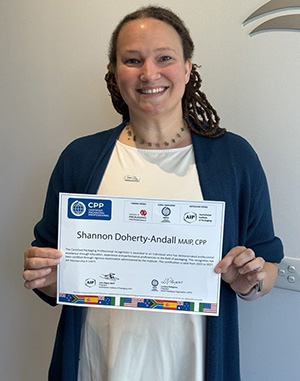
The AIP would like to take this opportunity to congratulate Shannon Doherty-Andall MAIP, CPP, Sustainability Manager, Australian Beverages Council on successfully achieving the Certified Packaging Professional (CPP) designation. The CPP program has been accepted as the global recognition as a packaging professional and therefore the CPP designation has now become the leading mark of excellence internationally and a must-have recognition of industry proficiency and achievement for packaging professionals.
.
We invited Shannon to share with us what attaining the Certified Packaging Professional Designation means to her…
 1. How long have you been in the industry? What are your areas of expertise?
Shannon:
I have been working across sustainability and packaging for around 10 years, with experience spanning food and beverage, pharmaceuticals, and broader packaging sustainability and policy. My key areas of focus include sustainable packaging design and reform, circular economy policy, and industry-led sustainability and extended producer responsibility programs, particularly in the non-alcoholic beverage sector. I also spend a lot of time working on the practical side of packaging challenges, helping businesses understand what upcoming requirements mean in the real world and how to prepare for them.
2. What made you apply for the Certified Packaging Professional (CPP) Designation?
Shannon:
I applied for the Certified Packaging Professional (CPP) program because I wanted to formally validate my packaging knowledge and strengthen the technical side of my work. Packaging sits at the intersection of sustainability outcomes, design choices, manufacturing realities, regulation, and consumer behaviour, and I have always believed it is important to be able to speak confidently across all of those areas. The CPP designation felt like a really strong way to reinforce that foundation, and to ensure I am continuing to grow professionally alongside the pace of change in the packaging space.
3. How important is attaining the CPP designation to you as an individual?
Shannon:
Becoming a Certified Packaging Professional is genuinely a meaningful achievement for me. I have put a lot of time into building my packaging expertise over the years, and earning the CPP designation feels like a clear milestone that reflects that work. On a personal level, it also gives me more confidence when I am engaging in complex technical discussions with industry, regulators, and stakeholders. It is also a reminder that the details matter, and that taking the time to deepen technical capability is always worth it.
4. How important is the CPP designation for the greater recognition of people in the packaging industry?
Shannon:
I think having the Certified Packaging Professional (CPP) designation is incredibly important. Packaging professionals are often solving high-impact problems every day, but the complexity of that work isn’t always recognised externally. Designations like the CPP help lift the visibility and credibility of packaging as a profession and reinforces that packaging is not just “a box or a bottle”; but rather that it is a highly skilled discipline that influences sustainability outcomes, product performance, safety, supply chain efficiency, and compliance.
5. Were there any new learnings or takeaways that you gained from the experience?
Shannon:
Yes, definitely. One of the biggest takeaways for me was how valuable it is to step back and revisit the fundamentals. Even if you work in packaging every day, the CPP process reinforces the technical building blocks and helps connect areas you may not always work across directly. It also strengthened my ability to think about packaging decisions more holistically, considering materials, performance requirements, machinery constraints, and end-of-life outcomes together, rather than in isolation.
6. What next for your career?
Shannon:
I am excited to keep building my work in sustainability and packaging into the next phase of my career, particularly where it supports real-world impact at scale. In the near term, I will continue focusing on industry sustainability priorities, practical implementation challenges, and supporting the packaging transition across areas like circular economy policy, extended producer responsibility systems, and packaging design improvements. I am also keen to continue growing in international policy and cross-sector collaboration, as packaging and sustainability challenges increasingly need global coordination and shared solutions.