


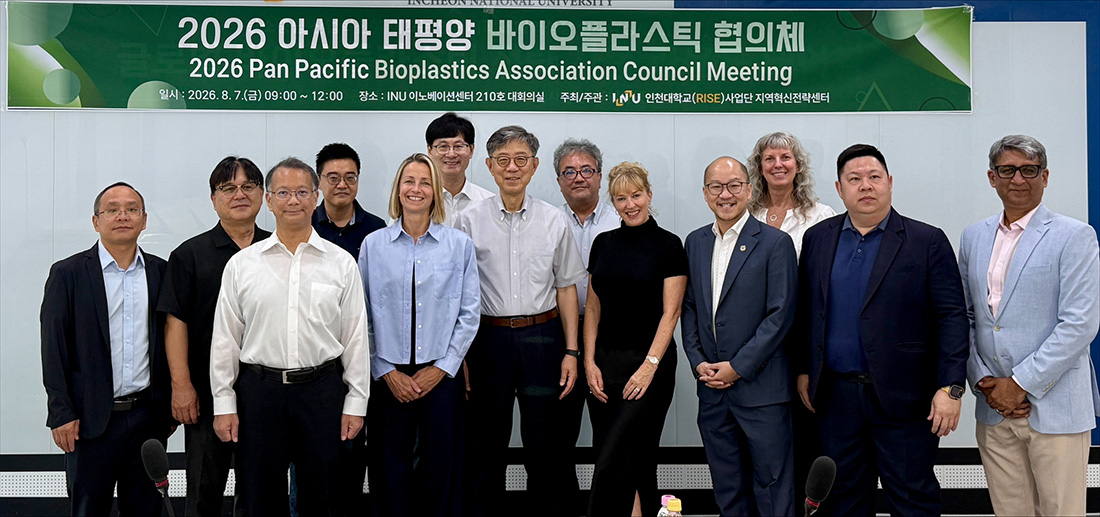
 The Pan Pacific Bioplastics Alliance leadership meeting in Incheon, August 2026. Pictured, L–R: Yunxuan Weng (Secretary General, CPPIA), Sangyong Kim (Vice President, KBPA), Akio Nakaishi (Chairman, JBPA), Lorenza Romanese (Secretary General, European Bioplastics), Dong-Ku Kang (Dean, Incheon National University), In-Joo Chin (President, KBPA), Hideo Yamada (Secretary General, JBPA), Martine Poulain (CEO, ABA), Tommy Tjiptadjaja (Chairman, PASTI), Margaret Eldridge (Certification Director, BPI), Chanon Phantusintu (President, TBIA), Vikram Bhanushali (President, ICPA).
INCHEON SOUTH KOREA- 10 August 2026 — As the European Union’s new Packaging and Packaging Waste Regulation (PPWR) takes effect this Wednesday, August 12 — reshaping the rules for compostable and bio-based packaging entering the EU market — bioplastics associations from across the globe have agreed to strengthen their collaboration, sharing knowledge and working together to win greater recognition for the sector’s role in the circular economy.
The commitment followed a meeting of global bioplastics peak-body leaders in Incheon, South Korea on Friday, 7 August, where Australasian Bioplastics Association (ABA) CEO Martine Poulain represented Australia and New Zealand. The meeting, convened by Dr In-Joo Chin, President of the Korean Bioplastics Association, followed the 2026 Global Conference on Sustainable Plastics at Songdo Convensia. ABA has been a founding member of the alliance since 2016, alongside associations from Japan, Taiwan, Vietnam and Thailand. Members agreed to retain the alliance’s current governance structure under a single president, and will now meet twice a year, with the next online meeting set for 10 March 2027. The next Global Conference on Sustainable Plastics has already been confirmed for Incheon in September 2027.
The timing is pointed for Australia, where inconsistent rules and public confusion over what “compostable” actually means have long held the sector back. South Australia introduced mandatory labelling requirements for certified compostable items earlier this year, giving consumers and processors a clearer way to identify genuine, certified products — the kind of consistency industry leaders say is needed more broadly, both within Australia and internationally.
With regulatory frameworks diverging by market both internationally and within Australia, industry leaders agreed that no single association can solve this alone, and committed to working more closely together. Leaders committed to:
- A joint advocacy framework, sharing resources and aligning messaging so each member association is better equipped to make the case for certified bioplastics in its own market.
- A shared communications initiative, equipping member associations to correct misinformation and reinforce, consistently, where bioplastics fit within circularity.
- An infrastructure knowledge-sharing network, exchanging successful international models for composting, organics collection and biogasification.
“The EU’s new packaging rules landing this same week are a reminder of how fast the regulatory landscape is moving, market by market — and we see the same fragmentation here at home, state by state. Certified bioplastics only deliver on their promise as part of a genuine circular system. What changed on Friday is that we’re no longer working this out on our own here in Australia. We now have every major bioplastics association across the region and beyond sharing what’s working and backing each other up.”
— Martine Poulain, CEO, ABA
.
For an industry that has too often worked out its answers alone, country by country, that collaboration is the real story. As regulation accelerates in Europe and infrastructure expands here at home, ABA and its international counterparts are no longer solving these problems in isolation — they’re sharing what works and solving them together.
.
www.bioplastics.org.au