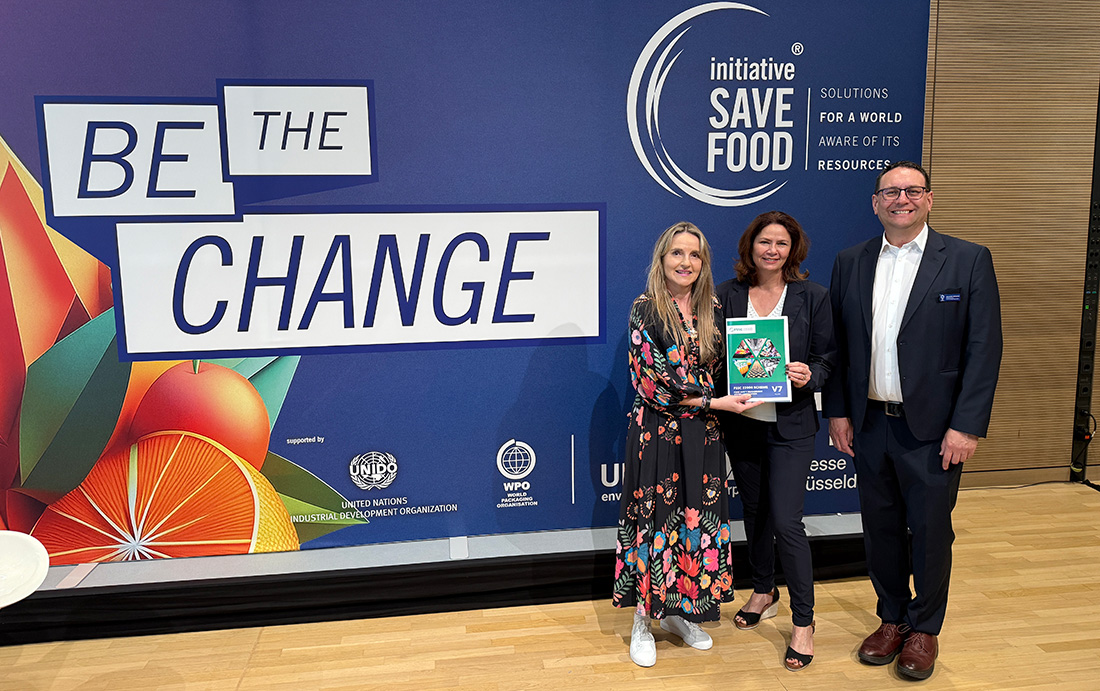


In 2021, Foundation FSSC became a member of the UN Global Compact to see how they could align their global vision ‘Creating a Better World’ with the 17 Sustainable Development Goals (SDGs).
.
As the owner of the global Certification Scheme FSSC 22000 for Food Safety, together with their Certified Organisations across the globe, they soon realised that the impact was going to be at grass-roots level within food organisations.
.
According to Kelly Mulholland, Technical Manager Safety & Quality at FSSC, “The first step was to create impactful solutions for food businesses via the tools available through FSSC.”
.
“To this end, we decided to add a specific requirement on Food Loss and Waste (FLW) in Version 6 of our Certification Scheme. As a result, more than 30,000 organisations were required to implement policies and strategies addressing FLW. This contributed to progress on SDG 12, Responsible Consumption and Production, and specifically Target 12.3,” she said.
.
The additional requirement on FLW was included in V6 in the Certification Scheme (Part 2, Section 2.5.16) and applies to all food chain categories except Category I (food packaging manufacturing).
The team at FSSC understood that packaging plays a vital role in reducing Food Loss and Waste, particularly in relation to the design of packaging materials.
.
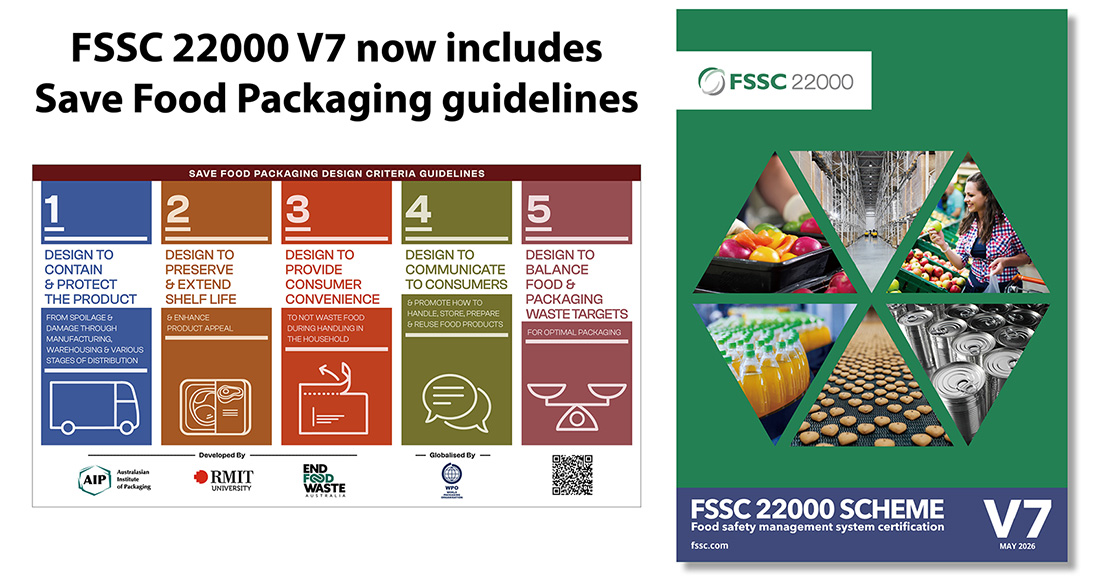
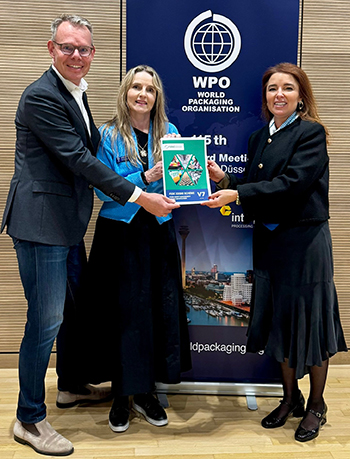 After joining the World Packaging Organisation (WPO), FSSC soon discovered that the Australasian Institute of Packaging (AIP) had already established a research-driven set of Save Food Packaging guidelines, in partnership with RMIT University and End Food Waste Australia. These guidelines have been designed to be implemented by macros, SMEs, and multinational food and beverage companies in any corner of the globe.
.
Kelly added that “To address this, we recently announced Version 7 of the FSSC 22000 Certification Scheme now incorporates a new requirement under product design and development, which applies to all organisations that design primary packaging and packaging material.”
Nerida Kelton, Vice President of Sustainability & Save Food for the WPO, and who is also the Executive Director of AIP, reminds everyone that “First and foremost, the true role of packaging is its functionality. Packaging needs to be designed to ensure that a product is protected, preserved, contained, and transported all the way through the value chain from production until it is used in the household.”
.
“Save Food Packaging is designed to minimise or prevent food waste from paddock to plate using innovative and intuitive design features that can contain & protect, preserve, extend shelf life, easily open and reseal, provide consumer convenience and portion control; all the while meeting global sustainable packaging targets”, she said.
.
Nerida strongly believes that “The inclusion of aspects of the Save Food Packaging design guidelines in Version 7 will have a significant impact for tens of thousands of food and feed companies involved in the processing, handling, or distribution of food products across the world.”
.
Kelly added that “Foundation FSSC now has over 40,000 Certified Organisations that are required to consider these packaging design principles, resulting in further support for the reduction of Food Loss and Waste.”
The packaging design requirements included within FSSC 22000 V7 (Part 2, 2.5.13) were developed with the support of the WPO, of which FSSC is an affiliate member, and the AIP, which is a Member of the WPO. The design requirements that in Version 7, are based on aspects of the AIP’s Save Food Packaging Design Principles, which have been globalised by the World Packaging Organisation (WPO).
.
FSSC looks forward to further collaboration with WPO and AIP on this important topic and creating even more impact within food companies across the world.
.
For more information on FSSC and the FSSC 22000 Certification Scheme, visit www.fssc.com